
UT Extension’s Role in Financial Literacy Across Generations
His students call him John Finance, a compliment for a musician and high school teacher. Tyler Reddick is not the TikTok finance guru, but he is among the nearly two thousand teachers across Tennessee who have been trained to teach personal finance since 2007 by UT Extension. The high school class became a state requirement for graduation in 2013.
This fourteen-hour training is among an array of money-management programs offered through the Extension Department of Family and Consumer Sciences. Others include the Money Week program for first and second graders, home-buyer education, money-saving and budgeting, retirement and aging planning, workforce training, and even Pat’s Gameplan, a collaboration with the Pat Summitt Foundation, for caregivers of people with dementia.
Reddick teaches personal finance at the Chattanooga High School Center for Creative Arts, a magnet school. A professional musician and producer, he was hired to teach students how to use the recording studio. Because he does not have a background in finance or economics, he was required to complete the training.
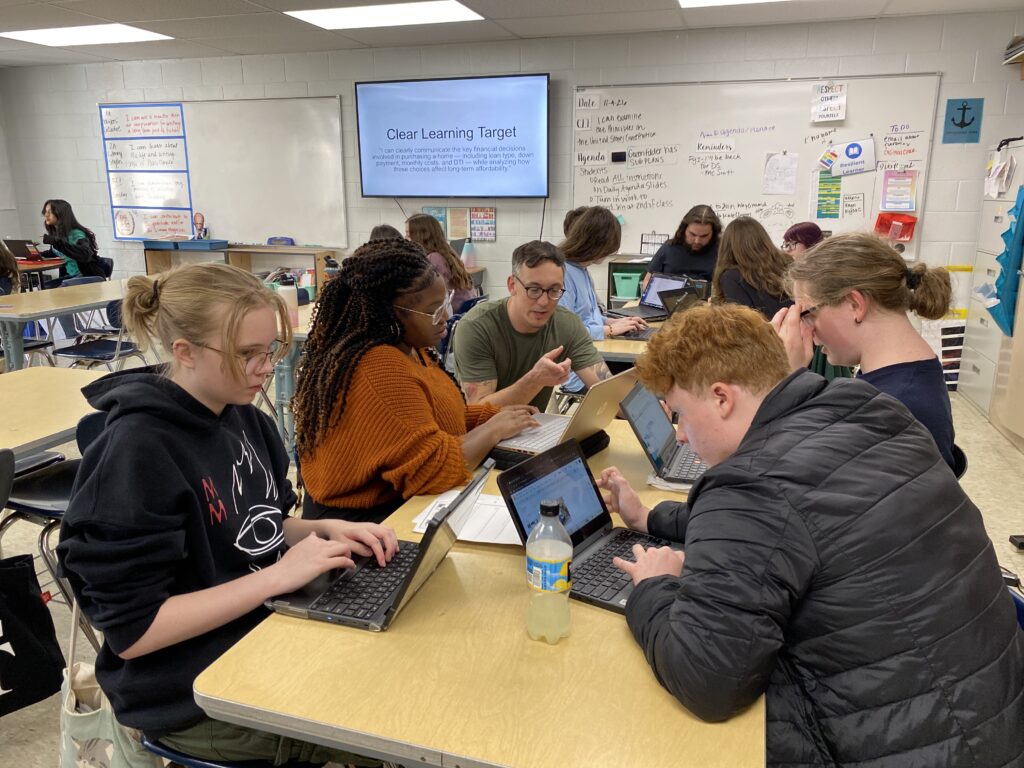

Teacher’s Benefit, Too
“I started using the budget apps we talked about,” Reddick says. “I feel like I learn something new every day, and I really have to be on my game to answer my students’ questions.”
Through the personal finance course, high school students learn about setting financial goals and making financial choices, spending and saving, and choosing a career, and the more nuanced parts of the financial system such as taxes, insurance, budgeting, renting versus buying a home, banking, consumer protection, credit and debt, borrowing, identity theft, and cryptocurrency.
Department faculty, including Ann Berry, assistant head and professor; Christopher Sneed, associate professor; and Karen Franck, associate professor and Extension evaluation specialist, recently surveyed personal finance teachers through a project funded by the National Endowment for Financial Education and the Financial Industry Regulatory Authority Investor Education Foundation.
The study recommended increasing the course from a half credit to a full credit; including teachers in the process of revising the standards; curating lists of lesson plans and websites; and encouraging teachers to share successful materials and resources. There is no textbook or set curriculum for the course. UT Extension shared the results with the Tennessee Department of Education with the hope that changes will be evaluated and possibly implemented.
Witnessing Students Master the Concepts
Family and Consumer Sciences faculty and Extension specialists and agents say they see firsthand the benefits of teaching money management and planning. In fact, Sneed and now-retired agent Jane Gault testified before the Tennessee House Education Committee about the need for the high school course in 2006 before it became a required course. “We teach living beneath your means so you have a cushion, using credit wisely, and planning for retirement,” says Berry, who came to UT Extension that year following more than twenty years with Louisiana State University Cooperative Extension.
And personal finance is applicable to all ages. Even children as young as three or four can understand money concepts, Berry explains.
This is where Money Week fits in. “If we start teaching money-saving habits earlier, they are more likely to adopt those habits and save money over time,” says Sneed, who oversees implementation of Money Week, funded in part by the Tennessee Financial Literacy Commission.
Money Week started as a pilot program at the Green Magnet Academy in Knoxville in 2021 and has since spread to about thirty counties. The money lessons are tied to literacy. Teachers read a book such as You Can’t Buy a Dinosaur with a Dime and introduce concepts like the value of money, counting currency, the difference between needs and wants, and spending and saving. Community leaders visit classrooms to read to children, who also get to take home a book and a newsletter of information for their parents or guardians.
Berry, Sneed, and their colleagues have devoted their careers to helping people succeed financially by promoting making good, sound decisions.
“Our core mission is improving the lives of Tennesseans whether on the farm, in the classroom, at home,” Sneed says. “What better way to do that than be good stewards of their financial resources?
Explore More on
Features
MORE FROM THIS ISSUE