Elizabeth Cathey, an undergraduate food science student in the Herbert College of Agriculture, strengthens her problem-solving and critical thinking skills in a food engineering course that incorporates artificial intelligence into its curriculum.
“I’ve learned a lot using AI in class. As we’ve solved complex problems on topics like energy balance and heat transfer, I’ve improved at using AI as a tool instead of a crutch.”
Generative artificial intelligence is changing the landscape of higher education. While the concerns about the misuse of AI increase, faculty like associate professor Jiajia Chen of the Department of Food Science seek to shift the mindset in Herbert classrooms toward use of AI as a tool for learning.
In spring 2025, Chen, along with department member and associate professor Vermont Dia and associate professor Jennifer Richards of the Department of Agricultural Leadership, Education and Communications, secured a US Department of Agriculture-funded Higher Education Challenge grant to incorporate AI into a food engineering course.
Their goal? To use AI for vital education that advances food and agricultural science and to meet the food industry’s growing demand for innovation.
A Year of Preparation
The faculty team spent a year redesigning a module taught in FDSC 341: Food Engineering to help students use AI tools to learn new concepts and develop problem-solving skills.
To ensure success, they taught students in the department’s capstone course how to effectively use AI in food product development. They also conducted a focus group to test AI-supported learning materials, seeking feedback from students on their experiences. This was the foundation for incorporating learning materials into the fall 2025 food engineering course.
AI-focused Learning
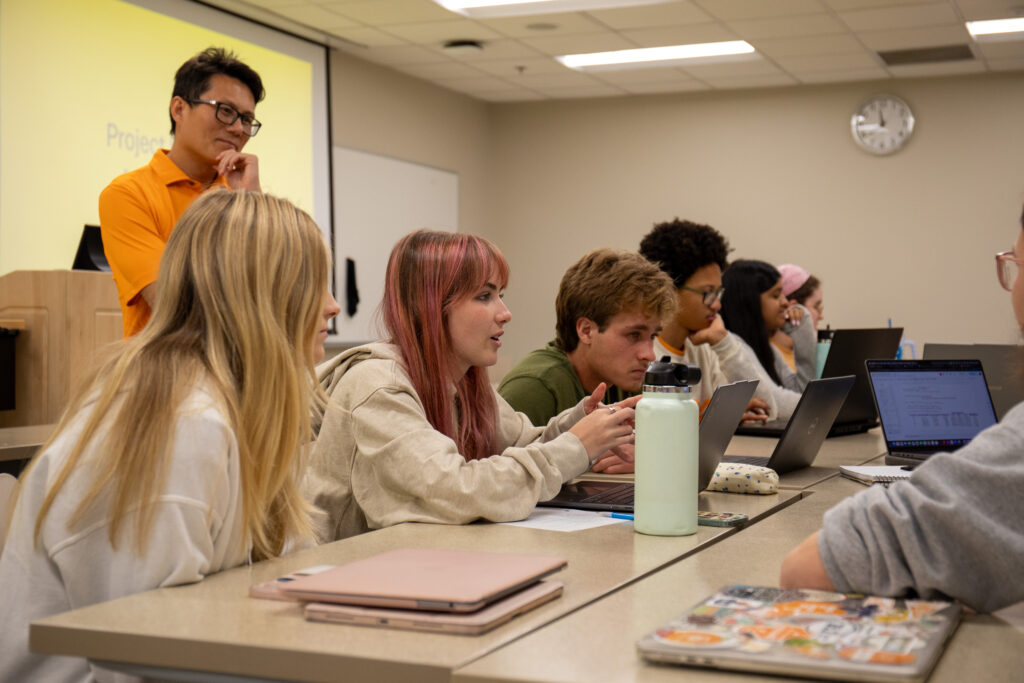
The class consisted of two investigative projects that incorporate food processing concepts, engineering optimization, and economic considerations into real-life settings. Working as a team, students interacted with AI to solve problems with knowledge not fully learned in lectures—a new experience for most.
To further immerse students in real-world scenarios, the team incorporated role play and active learning activities into the curriculum. Students acted as consultees, peer students (coworkers), and supervisors in interacting with AI tools “to rephrase their communication, review and critique AI’s responses, and revise AI’s solutions for better results,” says Chen.
Graduate student Ploy Wong adapted course lecture slides to include color-coded texts that emphasize different learning levels to remember, understand, and apply; guided AI prompts; and investigative AI homework exercises that support students’ understanding and exploration of engineering concepts.
Bridging Skepticism and Opportunity
Chen says students differ in their opinions about the usefulness of AI. Some believe AI tools often provide inaccurate or limited information, while others actively use AI tools to help with their active learning and research projects.
“I anticipate more students will appreciate the usefulness of using AI to improve their learning and working efficiency, considering the evolving accuracy and capabilities of AI tools,” he says.
Cathey explains how she uses AI to ask focused questions to interpret equations or clarify problem-solving steps. Because of this, she believes her critical thinking skills have improved tremendously. Additionally, she has “learned to be skeptical, cross-check information, and verify results.”
She adds, “At the beginning of the semester, I wasn’t very open to frequent AI use, but now I see that learning to use it effectively and ethically is critical as AI prepares to enter the workforce.”
Greater Impacts Ahead
The goal of this work is twofold: to deepen students’ understanding of food engineering concepts while equipping them with critical workforce skills such as problem-solving, communication, teamwork, ethical decision-making, and professionalism.
The faculty team also anticipates implications beyond UT—that the AI-focused curriculum in food engineering education may become a model for food science programs across the country.
A strong workforce starts in the classroom, but preparation is about more than just teaching students how to use advanced technology. These future food scientists are learning how to lead innovations in food processing.
Cathey, who aspires to a career in research and development, says, “I believe that gaining experience with these tools now is preparing me to become a more efficient and effective innovator in the food industry.”
AI in the College Classroom
Artificial intelligence becomes more integrated in higher education as students use it as a prompting tool and faculty harness it for efficiency. Several professors across the University of Tennessee, Knoxville, have received grants to incorporate AI into their curriculum and promote AI literacy.
Here are some of the ways Herbert College of Agriculture students and faculty use AI in the classroom:
Students
- Speaking Outlines
Students use AI tools to develop speaking outlines as guides when they give presentations. - Presentation Feedback
Students provide feedback on presentations by submitting their comments digitally, and AI generates the combined feedback into a summary for the presenter. - Virtual Reality
Through virtual reality, students practice their presentations in front of simulated audiences and use AI technology to ask questions and provide feedback. - Exam Preparation
AI combines a student’s class notes into a custom study guide for exams.
Faculty
- Course Planning
AI helps generate content for lesson plans, quizzes, presentations, and more. - Grammar Correction
When students use AI tools to correct grammar, efficiency increases for faculty who can focus on the substance of the assignment and actively participate in discussions. - Scanning for Plagiarism
Faculty use AI to easily scan assignments for plagiarism and ensure that students are generating ideas rather than copying and pasting. - Creating Access
Tools like text-to-speech and speech recognition help faculty meet accessibility standards and create a more welcoming environment.
Explore More on
Features
MORE FROM THIS ISSUE